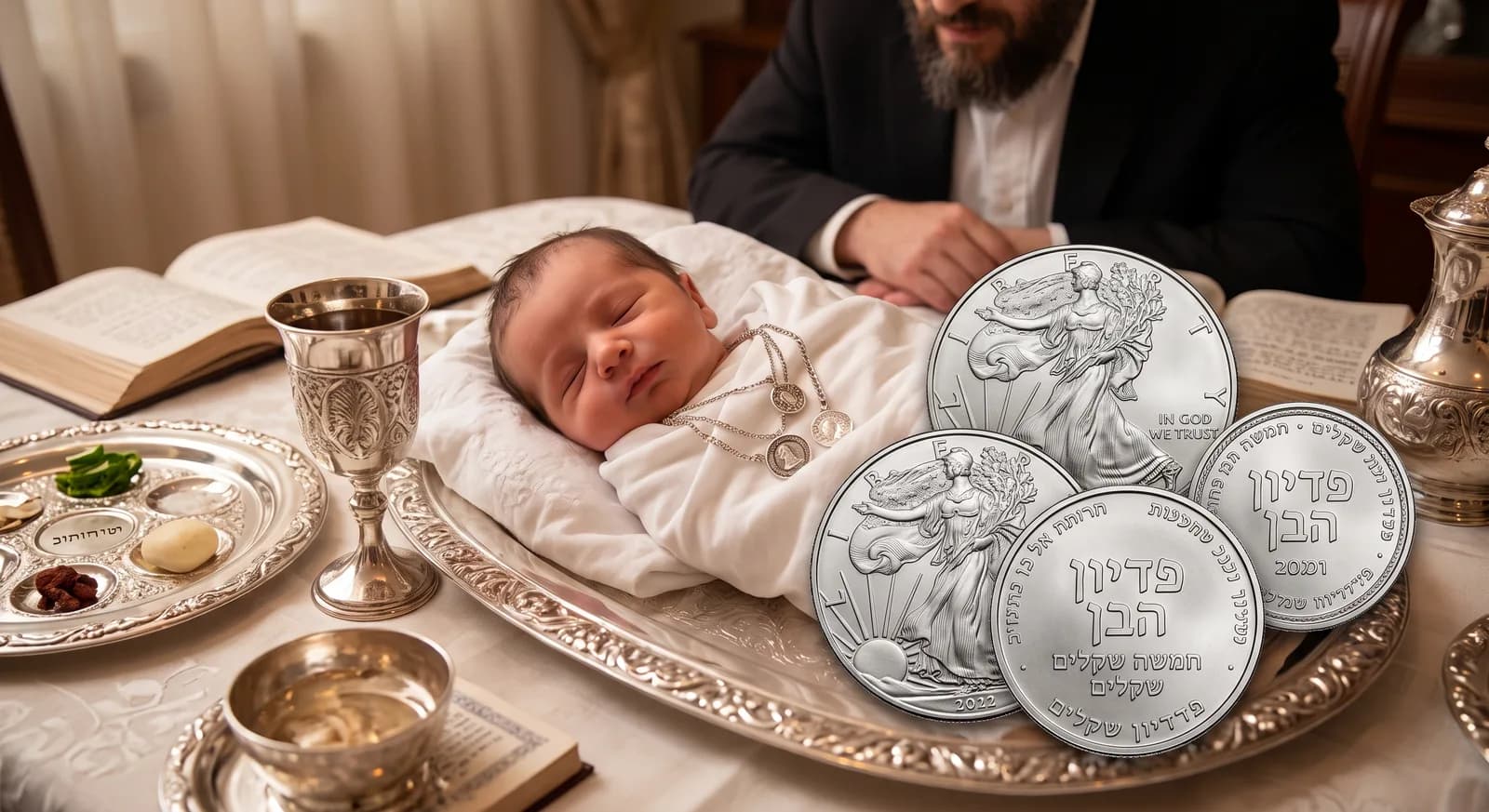
Need coins for a pidyon haben? We provide five 1 oz .999 pure silver coins, verified and with VAT included. Delivered directly to your door anywhere in Israel within 48 hours.
What Is Pidyon Haben?
Pidyon haben is the redemption of a firstborn son, taking place on the thirty-first day following his birth. The father gives a Kohen silver valued at five shekels of the Sanctuary, releasing the boy from the inherent sanctity the Torah assigns to every firstborn who opens the womb. The ceremony itself is brief, usually about ten minutes, and involves two blessings followed by a festive meal.
The mitzvah applies under highly specific conditions: the child must be a boy and his mother’s first natural birth. Furthermore, there can be no Kohen or Levi lineage on either side of the family. Circumstances such as a caesarean birth or a prior pregnancy that did not carry to term alter these requirements. For those specific scenarios, always consult a rav.
Historically, this practice stems from God sparing the Israelite firstborn in Egypt and claiming them as His own. Following the incident of the Golden Calf, the Levites replaced the firstborn in the Temple service. Ever since, every Israelite firstborn must be “bought back” from that original claim, with silver serving as the official purchase price. Notably, this is one of the few mitzvot where the Torah explicitly dictates the exact numeric value on the invoice.
Full disclosure before we dive into the numbers: I sell silver for a living. Weigh that as you read.
Key points
- Pidyon haben redeems a firstborn son from a Kohen on the 31st day after birth (Bamidbar 18:16; Shulchan Aruch, Yoreh De’ah 305).
- The Torah establishes the price at exactly five shekels of the Sanctuary, valued at twenty gerah each.
Sources: Bamidbar 18:15–16; Shulchan Aruch, Yoreh De’ah 305:1; Peninei Halacha, Mishpacha 9:1–5.
Where Does the Torah Command It?
The commandment appears in four distinct places. Shemot 13 consecrates the firstborn on the night of the Exodus and mandates their redemption, a command repeated in Shemot 34:20. Bamidbar 3 details how the Levites were swapped in, and the 273 remaining firstborn were redeemed at five shekels a head, which came to 1,365 shekels paid directly to Aharon and his sons. Finally, Bamidbar 18:16 makes the decree permanent:
“His redemption, from a month old you shall redeem, by your valuation in silver: five shekels by the shekel of the Sanctuary, twenty gerah.”
The Gemara (Sanhedrin 17a) records that Moshe settled the redemption of those 273 surplus firstborn using a lottery system of slips. From a professional standpoint, it is fascinating that the very first silver transaction in Tanach with a defined unit price is a pidyon. This twenty-gerah shekel is the identical weight system used for the half-shekel in Shemot 30:13, which we traced in our Machatzit HaShekel article.
Key points
- Bamidbar 3:46–51 documents 273 surplus firstborn redeemed at five shekels each, totaling 1,365 shekels.
- Shemot 30:13 explicitly defines the shekel of the Sanctuary as twenty gerah.
Sources: Shemot 13:2, 13:13–15, 30:13, 34:20; Bamidbar 3:11–13, 3:44–51, 18:15–16; Talmud Bavli, Sanhedrin 17a.
How Is Pidyon Haben Done in Israel Today?
The ceremony occurs on day 31, counting the baby’s birth as day one. If day 31 falls on Shabbat or Yom Tov, the pidyon is pushed to the following day; however, Chol HaMoed and Chanukah do not delay it. The event typically features a seudah and a minyan. The baby is brought in on a tray, and the Kohen formally asks the father whether he would rather keep his son or the silver. After selecting his son, the father recites the bracha on the pidyon and shehecheyanu, then hands over the coins. The ceremony concludes with birkat kohanim, a hearty mazal tov, and the meal.
Fathers acquire the necessary coins in a few different ways. Many kohanim keep their own set of five coins to either sell or outright gift to the father beforehand (Rav Ovadia Yosef explicitly details this arrangement, noting the father can settle up by check afterward). Gemachim also lend sets using a gift-and-return structure, because halachically, the father must fully own the silver on day 31. Alternatively, you can purchase your own set.
While Israeli commemorative pidyon sets exist (often containing 20- and 26-gram coins), Rav Eliezer Melamed points out that the government set has historically sold for at least four times its actual silver melt value. This high premium is exactly why many families now choose to buy five standard bullion ounces instead.
For olim, one critical factor often causes confusion: VAT. Silver purchased in Israel is subject to 18% VAT. Both Rav Ovadia and Rav Mordechai Eliyahu rule that the halachic valuation of the pidyon is the local retail price of the silver including that VAT. The five shekels must equal what it actually costs to buy that metal in Israel, today, in shekels. The London fix price is irrelevant here.
Crucially, the coins must belong entirely to the father. They cannot be borrowed or on a payment plan. While the Kohen can choose to gift them back after the ceremony (and many do), the initial giving must come with no strings attached.
Key points
- Pidyon haben takes place on the 31st day after birth and is delayed only for Shabbat and Yom Tov.
- Rav Ovadia Yosef and Rav Mordechai Eliyahu rule the pidyon silver must be valued at its Israeli retail price, inclusive of VAT.
Sources: Shulchan Aruch, Yoreh De’ah 305; Peninei Halacha, Mishpacha 9:2 n.1 and 9:6–8; Yalkut Yosef, Sova Semachot vol. 2; Machon Keter (keter.org.il); Rabbi Yirmiyohu Kaganoff, “The Halachos of Pidyon Haben.”
How Much Silver Do You Need?
The Torah’s five shekels equate to the Sages’ five sela’im. Since a sela is four dinar, and the Sages added a sixth to the original Torah weight, five sela’im amount to 1,920 barleycorns of pure silver. The Rambam translated this into the contemporary coin of his era, thirty dirhams. The Shulchan Aruch (Yoreh De’ah 305:1) codified this exact measurement: five sela’im equals thirty dirhams of refined silver.
The modern halachic split stems entirely from determining exactly what a historical dirham weighed:
- Rav Chaim Naeh calculated the Turkish dirham at 3.2 grams, resulting in 96 grams (rounded up to 101 to be safe).
- The Chazon Ish, despite disagreeing with him on almost every other measurement, arrived at the exact same 96 grams.
- Rav Ovadia Yosef evaluated medieval coins to place the Rambam’s dirham at 3.0 grams, ruling 90 grams. He noted that Jerusalem’s Sefardi custom was 31 dirhams, bringing the practical weight to 93 grams.
- Rav Eliezer Melamed notes the dirham was likely 2.83 grams in the Rambam’s era (making the original requirement roughly 85 grams). However, citing the Bach and Knesset HaGedolah, he advises treating it as 100 grams to account for any historical inaccuracies.
- Chabad practice requires 103 grams.
- Machon Keter calculates 96 grams but publishes a daily rate based on 100 grams.
| Authority | Dirham (g) | Five sela’im (g) | Troy oz | In practice |
| Rav Ovadia Yosef (Sefardi) | 3.0 | 90 | 2.89 | 93 g / 2.99 oz (Jerusalem custom, 31 dirham), VAT incl. |
| Rav Chaim Naeh | 3.2 | 96 | 3.09 | 101 g / 3.25 oz |
| Chazon Ish | — | 96 | 3.09 | 96 g / 3.09 oz |
| Rav Chaim Kanievsky / Pri Adamah | — | — | — | 101 g / 3.25 oz |
| Rav Eliezer Melamed (Peninei Halacha) | 2.83 | ~85 | ~2.73 | 100 g / 3.22 oz |
| Chabad practice | — | — | — | 103 g / 3.31 oz |
| Machon Keter | — | 96 | 3.09 | 100 g / 3.22 oz |
| Israeli commemorative sets (1973) | — | — | — | ~117 g / 3.76 oz pure (5 × 26 g at .900) |
Troy ounce = 31.1035 g. Source: Shiurei Torah p. 82; Yechaveh Daat 4:54; Yalkut Yosef, Sova Semachot II; Peninei Halacha 9:2 n.1; Machon Keter; shulchanaruchharav.com; Rabbi Kaganoff; Winner’s Auctions (IGCMC 1973 set).
The magic number is 100 grams of pure silver (roughly 3.2 troy ounces). This satisfies everyone from Rav Ovadia to the Chazon Ish, including all Jerusalem stringencies. Even if your rav specifies 93 or 96 grams, you are fully covered. If you want the extra buffer of the commemorative coin sets, 124 grams (four ounces) is sufficient.
But practically, the universal custom is to give five coins. Nobody has ever regretted handing the Kohen an extra ounce.
Key points
- Rav Chaim Naeh and the Chazon Ish both establish five sela’im at 96 grams of pure silver.
- Rav Ovadia Yosef ruled 90 grams by law and 93 grams by Jerusalem custom, valued at the local Israeli price including VAT.
Sources: Talmud Bavli, Bechorot 49b–50a; Rambam, Hilchot Shekalim 1:2–3 and Hilchot Eruvin 1:12; Shulchan Aruch, Yoreh De’ah 294:6 and 305:1; Rav Chaim Naeh, Shiurei Torah p. 82; Rav Ovadia Yosef, Yechaveh Daat 4:54; Peninei Halacha, Mishpacha 9:2 n.1; Rav Shlomo Ishon, Torah VeHa’aretz Institute; Rabbi Eli Mansour, Daily Halacha #2259.
Which Coins Work?
Halacha allows for anything movable worth five sela’im, strictly excluding land, slaves, and documents (Yoreh De’ah 305:3). The established custom is to use silver coins.
What does not work:
- Checks, because they are classified as documents.
- Banknotes, as ruled out by the Aruch HaShulchan (305:18).
- Modern shekel coins, which contain no silver.
The Chatam Sofer (Yoreh De’ah 134) made it simple: a legal-tender coin only counts for a pidyon to the extent of the actual silver inside it. Old silver dollars worked perfectly; modern pocket change does not.
This is why a standard 1 oz bullion coin is the perfect solution. A Canadian Maple Leaf, for instance, has a face value of five Canadian dollars, but nobody treats it as five dollars. It is 31.1 grams of .9999 silver. It provides silver by weight, matching the exact description of the Shulchan Aruch’s thirty dirhams. Because it is a sovereign-minted coin, the custom is upheld, and the government assay removes the old anxiety of having a “light” coin (which used to prompt families to throw in a sixth coin just in case).
Five 1 oz coins equal 155.5 grams of pure silver. This easily clears every single threshold in the halachic table above, including the 117-gram buffer of commemorative sets. While four coins would technically cover the weight requirement, five is the universal custom and exactly what people expect to see on the tray.
Regarding pricing: as of September 24, 2026, our mixed-mint 1 oz sovereign coin lists at approximately ₪281 with VAT, making a set of five around ₪1,400. Because prices move daily with the silver spot market, check the live price before ordering or track the silver price in shekels. Be sure to order by day 25. In-stock lines ship within 48 hours, but halachically, the coins must be your paid property before the ceremony begins. Keep your receipt: that VAT-inclusive shop price is the exact valuation Rav Ovadia requires.
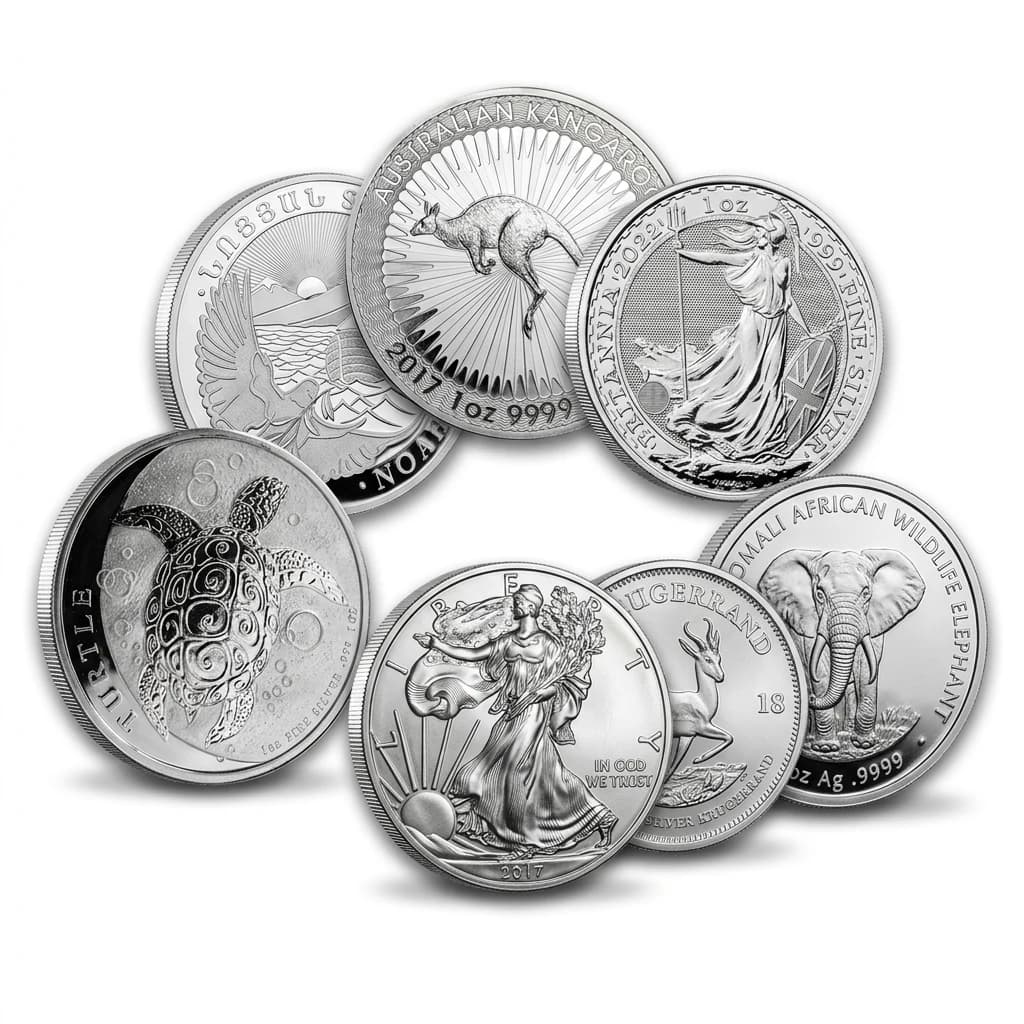
| Coin | Purity | Five coins (g / troy oz) | Stock |
| 1 oz Silver Sovereign Coin (Mixed Mint) | .999 | 155.5 g / 5.00 oz | In stock |
| 1 oz Canadian Silver Maple Leaf | .9999 | 155.5 g / 5.00 oz | In stock |
| 1 oz Britannia (Charles III) | .999 | 155.5 g / 5.00 oz | In stock |
| 1 oz American Silver Eagle | .999 | 155.5 g / 5.00 oz | By order |
| 1 oz Australian Kangaroo | .999 | 155.5 g / 5.00 oz | By order |
Source: lavisilver.com product pages, September 24, 2026. Troy ounce = 31.1 g.
Key points
- Pidyon haben cannot be fulfilled with a check, a banknote, or a modern shekel coin (Shulchan Aruch, YD 305:3; Aruch HaShulchan 305:18).
- Five 1 oz .999 silver coins contain 155.5 grams of pure silver, thoroughly exceeding every halachic opinion.
Sources: Shulchan Aruch, Yoreh De’ah 305:3 with Shach; Aruch HaShulchan, Yoreh De’ah 305:18; Chatam Sofer, Yoreh De’ah 134; Peninei Halacha, Mishpacha 9:2; Rav Shlomo Ishon, Torah VeHa’aretz Institute; lavisilver.com (Sept 24, 2026).
Frequently Asked Questions
Q: How much silver do I need for a pidyon haben?
A: 100 grams of pure silver satisfies every mainstream opinion. Rav Ovadia Yosef rules 90 to 93 grams, Rav Chaim Naeh and the Chazon Ish rule 96, and the common stringency is 100 to 103. This equates to roughly 2.9 to 3.3 troy ounces. Five 1 oz .999 silver coins hold 155.5 grams (5 troy ounces), which sits comfortably above all requirements.
Q: Can I use shekels or a check for pidyon haben?
A: No. Modern shekel coins lack any silver content, the Aruch HaShulchan disqualifies banknotes, and the Shulchan Aruch excludes checks because they are considered documents. The Kohen requires actual silver by weight, or an alternative movable object worth five sela’im.
Q: Does the Kohen give the coins back?
A: He may, and many kohanim do return them as a gift afterward. However, the father must hand the coins over outright, with no conditions attached. Whatever the Kohen decides to do next is entirely up to him (Peninei Halacha, Mishpacha 9:8).
Ordering coins for a pidyon haben? We offer five 1 oz .999 sovereign-mint coins, fully verified with VAT included. Enjoy tracked delivery across Israel within 48 hours. Order by day 25 to ensure they are in your hands well before the ceremony.
Have questions on timing or which coins to select? Book a free call with us.