From First Temple stone weights to Great Revolt coins to your shul’s pushka on Purim — tracing 3,000 years of the half shekel through Gemara, Rishonim, archaeology, and modern practice.
Interested in Silver with 3,000 Years of Jewish History?Lavi Silver Group helps Israeli investors acquire physical silver — the same metal that built the Mishkan, funded the Beit HaMikdash, and fueled a revolt against Rome.Book a Free Consultation → lavisilver.com/contact
Every year before Purim, Jews around the world give zecher l’machatzit hashekel — a commemorative charity donation recalling the annual half-shekel Temple tax. But here’s the question almost nobody asks: how much silver was the original half shekel, and does what we give today actually match? The answer takes us through archaeological digs beneath the Temple Mount, Talmudic currency debates, medieval barley experiments, and a 2,000-year-old coin found by an eight-year-old boy.
What Does the Torah Say About the Half Shekel’s Weight?
The Torah establishes the mitzvah of the machatzit hashekel in Parshat Ki Tisa. Every male Israelite aged twenty and above was required to contribute a half shekel to the Mishkan — and later, to the Beit HaMikdash — as an act of atonement and census.
בֶּקַע לַגֻּלְגֹּלֶת מַחֲצִית הַשֶּׁקֶל בְּשֶׁקֶל הַקֹּדֶשׁ עֶשְׂרִים גֵּרָה הַשֶּׁקֶל“A beka per head, half a shekel by the shekel of the sanctuary — twenty gerahs to the shekel — a half shekel as an offering to Hashem.”— Shemot 30:13
The Torah defines the shekel as 20 gerahs and a half shekel (beka) as 10 gerahs. But critically, it never anchors these measurements to an absolute weight we can convert to grams. The Torah assumed everyone knew what a shekel weighed — it was the standard unit of the ancient Near East, as obvious as saying “a kilogram” today.
So how do we know what it actually weighed? Two paths converge: what archaeologists have dug up, and what the Chazal, Rishonim, and Acharonim calculated. As we’ll see, these paths don’t always agree.
▸ The Torah defines a half shekel (beka) as ten gerahs of silver.▸ The biblical shekel standard predates coinage by over five centuries.
What Have Archaeologists Actually Found?
First Temple Period: The Stone Weights
During the First Temple era (c. 960–586 BCE), there were no coins. Commerce was conducted by weighing raw silver on balance scales using standardized dome-shaped limestone weights. Hundreds of these weights have been recovered from excavations across the Kingdom of Judah, and they tell a remarkably consistent story.
According to the Temple Mount Sifting Project, the Judahite weights are based on a shekel unit of approximately 11.33 grams. Common denominations include 1, 2, 4, and 8 shekels. Several weights inscribed with the word בקע (beka — the Torah’s own term for “half shekel”) have been discovered, allowing archaeologists to extrapolate a half-shekel weight of approximately 5.67 grams.
[Image: Beka weight stone from First Temple period. Photo: Eliyahu Yanai, City of David. Source: Times of Israel / IAA]
Key DiscoveryIn 2020, a dome-shaped limestone weight was found during excavations at Wilson’s Arch, adjacent to the Western Wall. It was inscribed with the Egyptian hieratic symbol for “shekel” and two lines denoting “two shekels.” It weighed exactly 23 grams — perfectly consistent with a single shekel of 11.5 grams.The IAA excavation directors Dr. Barak Monnickendam-Givon and Tehillah Lieberman noted: “The accuracy of the weight attests to advanced technological skills as well as the importance attributed to precise trade and commerce in ancient Jerusalem.”[Image: Two-shekel weight (23g) from Wilson’s Arch, 2020. Photo: Shay Halevi / Israel Antiquities Authority]
One complication: the Temple Mount Sifting Project notes that while the archaeological shekel weights divide into 24 gerahs per shekel (the Second Temple standard), the Torah’s description of 20 gerahs per shekel “has not been fully substantiated by archaeological finds.” This discrepancy points to the revaluation the Gemara discusses — more on that below.
▸ Judahite stone weights establish the First Temple shekel at approximately 11.33 grams.▸ The Wilson’s Arch two-shekel weight (23g) confirms the 11.5g-per-shekel standard.
Second Temple Period: The Tyrian Shekel
By the Second Temple period, coins had replaced raw weights. The Mishnah (Bechorot 8:7) specifies that the Tyrian shekel was the only currency acceptable for the Temple tax. These coins, minted in the Phoenician city of Tyre from 126 BCE onward, were prized for their exceptional silver purity — consistently 94% or higher — far exceeding any other contemporary currency.
The full Tyrian shekel (a Greek tetradrachm) averaged 14.2 grams and paid the tax for two people. The Tyrian half shekel (didrachm) weighed approximately 7 grams — the actual coin each man gave.
There’s a profound irony here that the rabbis had to navigate: these coins bore the image of Melqart-Herakles, a pagan deity, on one side and an eagle on the other — both arguably violations of the Second Commandment. Yet the rabbis determined that the commandment’s requirement for proper weight and purity overrode concerns about the imagery. The Mishnah (Kelim 12:7) ruled that a valid coin cannot become ritually impure, effectively rendering the pagan images halachically irrelevant.
[Image: Tyrian half-shekel coin (~7g, 94%+ silver), Melqart-Herakles on obverse, eagle on reverse. Public domain, Wikimedia Commons.]
▸ The Tyrian half shekel weighs approximately 7 grams of 94%+ pure silver.▸ The Mishnah mandates Tyrian silver as the sole currency for Temple tax.
The Great Revolt: Jewish Silver Coins
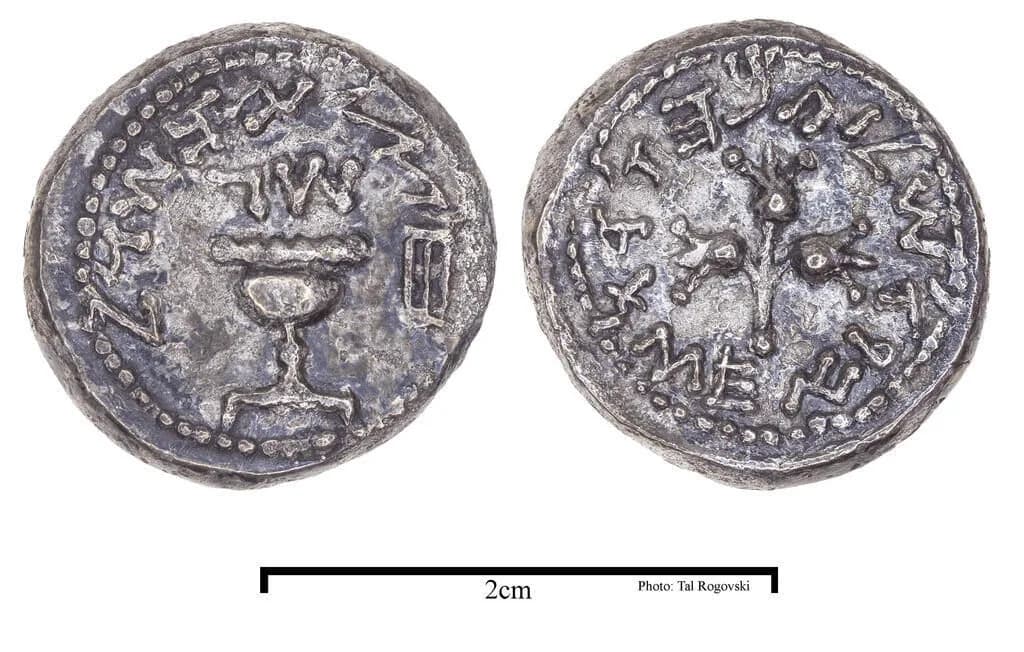
When the Great Revolt against Rome erupted in 66 CE, Jewish rebels in Jerusalem did something unprecedented: they minted their own silver coins. For the first time in history, Jews struck silver currency — shekels, half shekels, and quarter shekels — inscribed in paleo-Hebrew with ירושלים הקדושה (“Holy Jerusalem”) and חצי השקל (“Half Shekel”).
These coins were a deliberate replacement for the Tyrian shekels, using Jewish symbols (a chalice and three pomegranates) instead of pagan imagery. But they maintained the same weight standard: approximately 14 grams for a full shekel and 7 grams for a half shekel.
Metallurgical analysis of 32 silver revolt coins (23 shekels and 9 half shekels) revealed an extraordinary finding: the silver content consistently exceeded 98% purity — even higher than the Tyrian coins. This quality held steady across all five years of the revolt, even as Jerusalem was under siege and the Roman army tightened its grip. The rebels’ commitment to minting pure silver was both an economic and theological statement.
[Image: Great Revolt half-shekel (~7g, 98%+ silver), Year 3 (69 CE), found at Ophel excavation 2022. Photo: Tal Rogovski, courtesy Armstrong Institute of Biblical Archaeology.]
How Rare Are These Coins?Half-shekel coins from the Great Revolt are among the rarest finds in Israeli archaeology. A comprehensive survey of 93 archaeological sites recorded 3,492 revolt-era coins, of which only 17 were silver (all denominations combined). As of 2023, only about half a dozen half-shekel coins have been found in controlled excavations across the country.One was discovered by an eight-year-old boy during the Temple Mount Sifting Project. Another turned up in a Judean Desert cave during the search for Dead Sea Scrolls. The most recent, from Year 3 of the Revolt (69 CE), was found at the Ophel excavation site south of the Temple Mount in 2022 — only the third such coin ever found in Jerusalem.▸ Great Revolt half-shekel coins weigh approximately 7 grams of 98%+ pure silver.▸ Only 17 silver revolt coins have been found across 93 archaeological sites in Israel.
Archaeological Weights: The Complete Picture
| Period | Source | Full Shekel | Half Shekel | Troy Ounces (½) |
| First Temple (Iron Age) | Inscribed beka / shekel stone weights | ~11.33–11.5g | ~5.67g | ~0.18 ozt |
| Second Temple (126 BCE–66 CE) | Tyrian shekel / half-shekel coins | ~14.2g | ~7.0g | ~0.225 ozt |
| Great Revolt (66–70 CE) | Jewish rebel silver coins | ~14.0g | ~7.0g | ~0.225 ozt |
| Bar Kokhba (132–135 CE) | Overstruck on Roman tetradrachms | ~14.0g | ~7.0g | ~0.225 ozt |
Table 1: Archaeological evidence — actual weights of shekels and half shekels recovered from excavations in Israel.
What Do the Gemara and Rishonim Say About Shekel Weight?
The Gemara’s Foundation
The Talmud establishes several critical principles that shape all subsequent halachic discussion of the shekel’s weight:
Kiddushin 11b — Rav Yehuda says in the name of Rav Asi: “All silver amounts specified in the Torah are Tyrian silver” (כל כסף קצוב האמור בתורה כסף צורי). This anchors the shekel to the Tyrian standard — a real, physical coin that we can weigh archaeologically.
Bechorot 50a–51b — This sugya discusses the shekel’s weight in the context of Pidyon HaBen (5 shekalim paid to a Kohen). The Gemara equates the Torah’s shekel to a sela, establishing: 1 sela = 4 dinarim. It also addresses the critical 20% revaluation of the shekel from 20 gerahs to 24 gerahs — the tosefet chomesh — which effectively increased the monetary unit during the Second Temple period.
Shekalim 2a (Yerushalmi) — Discusses the machatzit hashekel and its denominational equivalencies, including the ancient geramasin coins (each worth 1/6 of a half shekel).
Bechorot 50a further records Rava’s statement that the shekel of the Torah was worth 3⅓ Tyrian dinarim, reflecting the pre-revaluation standard. The revaluation brought it to 4 dinarim — exactly matching the Tyrian tetradrachm coin that was actually used in practice.
▸ The Gemara (Kiddushin 11b) anchors all Torah silver to the Tyrian standard.▸ The Second Temple shekel was revalued from 20 to 24 gerahs — a 20% increase.
The Rishonim: Calculating Absolute Weight
The Rishonim faced a challenge the Gemara didn’t: converting the shekel into terms their contemporaries could use. Without access to the original Tyrian coins, they relied on cross-referencing Talmudic currency ratios with coins available in their own eras.
Rambam (Hilchot Shekalim 1:2–5) provides the most detailed treatment. He defines the half shekel as 160 barleycorns of silver. He also equates a quarter-shekel to the “golden dinar of the Arabs” — a well-known coin of his era weighing approximately 4.25 grams — placing a full shekel at approximately 17 grams. In his Commentary on Mishnah Bechorot 8:7, he further calibrates the perutah (the smallest unit) as half a barleycorn’s weight of pure silver, allowing calculation upward through the denominational chain.
Rashi (Shemot 21:32) provides the definitive Ashkenazic calculation. Commenting on the thirty-shekel indemnity for a slain slave, Rashi writes: וְהַשֶּׁקֶל מִשְׁקָלוֹ אַרְבָּעָה זְהובִים שֶׁהֵם חֲצִי אֻנְקִיָּא לְמִשְׁקַל הַיָּשָׁר שֶׁל קוֹלוֹנְיָ״א — “A shekel weighs four gold coins, making half an ounce according to the correct weight of Cologne.” The Cologne Mark (Kölner Mark), the dominant weight standard of medieval Ashkenazic Europe (~234g per Mark, or ~14.6g per ounce), places a full shekel at roughly 14 grams and a half shekel at ~7 grams. Remarkably, this aligns almost exactly with the Tyrian archaeological evidence.
[Image: Rashi on Shemot 21:32 (Sefaria screenshot) showing the Cologne weight reference — למשקל הישר של קולוני״א]
The Rif (Kiddushin 12) follows the Rambam’s barleycorn method, arriving at a similar result calibrated to the Arab golden dinar.
▸ Rashi (Shemot 21:32) equates the shekel to half an ounce by the Cologne Mark standard (~14g).▸ The Rambam calculates a half shekel at 160 barleycorns of silver (~8.5g).
A Medieval Experiment
One of the most fascinating episodes in this history comes from Rav Menachem in medieval Europe, who actually weighed barley seeds to calculate the shekel. His experiments, conducted at different times and with different varieties of barley, yielded a shekel weight of 15.3–15.9 grams — notably lighter than the Rambam’s 17 grams. The discrepancy is attributed to differences in barley seed size between European and Middle Eastern/North African varieties — a reminder of how organic measurement standards introduce natural variation.
How Did Later Poskim Determine the Weight?
The Acharonim inherited the Rishonim’s calculations and attempted to fix them into precise, actionable measurements for their own eras. The result is a well-known machlokes that persists to this day:
| Authority | Source | Full Shekel | Half Shekel | Troy Oz (½) |
| Rambam (via Arab dinar) | Hilchot Shekalim 1:5 | ~17g | ~8.5g | ~0.27 ozt |
| Rashi (Shemot 21:32) | Cologne Mark — ½ ounce | ~14g | ~7g | ~0.225 ozt |
| Rav Chaim Naeh | Shi’urei Torah (1947) | ~19.2g | ~9.6g | ~0.31 ozt |
| Rabbi Shneur Zalman of Liadi | Piskei Siddur | ~20.4g | ~10.2g | ~0.33 ozt |
| Chazon Ish | Kuntres HaShiurim | ~22.8g | ~11.4g | ~0.37 ozt |
| Archaeological evidence | Tyrian & Revolt coins | ~14g | ~7g | ~0.225 ozt |
Table 2: Halachic calculations vs. archaeological findings. Note the significant gap between what was actually used in the Temple and what later poskim calculate.
The widely cited “9 grams” figure that appears in many contemporary halachic guides represents a middle ground — derived from the Rambam’s 160-barleycorn calculation, with barleycorn weights estimated at approximately 0.05–0.056 grams each. It sits between the Rambam’s strict calculation (~8–8.5g) and Rav Chaim Naeh’s shiur (~9.6g).
Additional important voices include Rav Moshe Feinstein (Igrot Moshe YD 1:107, 1:190, 3:46:2, 3:66:1), who provides his own weight calculations; the Chochmat Adam (103:1), who discusses adapting to contemporary currency; and the Aruch HaShulchan HaAtid, who anticipates that the half-shekel in messianic times will be based on the most substantial coin in circulation at that time.
The Central TensionThe coins that the Kohanim actually accepted in the Beit HaMikdash weighed 7 grams. The halachic tradition, working from barleycorn calculations and medieval cross-references, arrives at 8.5–11.4 grams. The poskim’s figures are 28–63% heavier than what people actually gave during the Temple period. This inflation occurred through successive recalculations, the 20% Second Temple revaluation (tosefet chomesh), and calibration against medieval currencies the original authorities never handled.▸ Rav Chaim Naeh’s widely followed shiur places the half shekel at 9.6 grams.▸ Archaeological coins from the Temple period weigh 7 grams — 28–63% lighter than halachic calculations.
Are We Required to Give the Machatzit HaShekel Today?
The short answer is no — the biblical obligation is dormant. The Rambam (Hilchot Shekalim 1:8) rules explicitly that the shekalim are only practiced when the Beit HaMikdash is standing. Without the Temple, the obligation does not apply — not even in Eretz Yisrael.
What we practice today is a minhag — zecher l’machatzit hashekel, a remembrance of the half shekel. This custom is codified by the Rama (Orach Chaim 694:1) and practiced widely among both Ashkenazi and Sephardi communities before Purim, typically at Mincha on Taanit Esther or before the Megillah reading.
An important terminological caution applies here. The Geonim warn that one must never call this donation “machatzit hashekel” — only “zecher l’machatzit hashekel” (a commemoration of the half shekel). Calling it by its original name could theoretically consecrate the money as hekdesh, making it forbidden to use. Rav Schachter and the Chazon Ovadyah both emphasize this distinction.
▸ The biblical machatzit hashekel obligation is dormant without the Beit HaMikdash.▸ Today’s practice is zecher l’machatzit hashekel — a minhag, not a Torah obligation.
Who Gives?
The baseline obligation mirrors the original Torah requirement: males aged 20 and up. However, in practice the Mishnah Berurah (694:5) mentions that the widespread minhag is for a man to give on behalf of his wife and minor children as well. Many Ashkenazi communities follow this, and some opinions extend it to every household member.
The Rama notes an important caveat: once you start giving for your children, even young ones, you shouldn’t stop — it acquires the status of a personal neder (vow). Maran HaGR’ Chaim Kanievsky zt“l followed the practice of giving even for an unborn child in the womb.
One critical halachic boundary: zecher l’machatzit hashekel cannot double as matanot la’evyonim. The Mishnah Berurah (694:3) is clear that the money for each must be separate. They have different origins, different purposes, and different timing. Bundling them would violate the principle of ein osin mitzvot chavilot chavilot — we don’t bundle mitzvot together.
How Much Should You Actually Give in Israel Today?
This is where Ashkenazi and Sephardi practice diverge, and where the weight question becomes very practical:
Ashkenazi Practice
The Rama’s baseline: give three half-denomination coins of your local currency. The three coins correspond to the three mentions of “terumah” in Parshat Ki Tisa. In Israel, this means 3 × ½ shekel coins = ₪1.50. In America, 3 × half-dollar coins = $1.50.
This is the standard practice in most Ashkenazi shuls — the gabbai sets out half-dollar coins (or half-shekel coins in Israel), you pick them up, put them back down, and give the equivalent monetary value to tzedakah.
Many machmir Ashkenazi poskim, however, hold that the donation should reflect the actual silver value of the original half shekel. Rav Shlomo Zalman Auerbach’s minhag was to use three half-dollar coins minted before 1964 (when American half-dollars contained 90% silver). Rav Chaim Kanievsky gave ₪40 (~$11) per person as a hiddur, also using pre-1964 silver half-dollars.
Sephardi Practice
Sephardi poskim are generally more specific about the silver value. The Chazon Ovadyah (p. 103) writes that one should give the value of 9 grams of pure silver, while also giving 3 coins in accordance with the Rama. The OU’s Sephardic halacha guide states that one who cannot afford the value of 9 grams may give a fraction of any currency instead.
What It Costs in 2026
| Approach | Basis | Per Person | Family of 6 |
| Basic Ashkenazi (Israel) | 3 × ½ shekel coins | ₪1.50 | ₪9 |
| Basic Ashkenazi (US) | 3 × half-dollar coins | $1.50 | $9 |
| Archaeological half shekel | 7g silver at spot | ~$17.50 / ₪99 | ~$105 / ₪594 |
| Sephardi / Chazon Ovadyah | 9g silver at spot | ~$22.50 / ₪127 | ~$135 / ₪762 |
| R’ Chaim Kanievsky zt"l | Silver half-dollars + hiddur | ~$11 / ₪40 | ~$66 / ₪240 |
| Chabad (2026) | Baal HaTanya shiur (10.2g) | ~$25.50 / ₪144 | ~$153 / ₪864 |
Table 3: Practical costs of zecher l’machatzit hashekel in 2026. USD prices based on silver spot ~$78/troy ounce (Feb. 19, 2026). Israeli shekel prices based on physical silver at ₪440/troy ounce. Silver prices fluctuate — check the current rate before Purim.
Spot Price or Market Price?
For those who calculate based on silver weight, a practical question arises in Israel: do you use the global spot price of silver (~$78/troy ounce as of February 19, 2026), or the physical market price in Israel (~₪380/troy ounce)?
The original machatzit hashekel was defined by weight — pure silver content. The Torah wasn’t asking people to “go buy a coin at the money changer and pay whatever premium he charges.” So logically, the intrinsic metal value — the spot price — is the appropriate basis. Premiums and VAT are market friction costs, not the value of the silver itself.
That said, this is genuinely a she’elah worth posing to your rav.
▸ The Rama codifies giving three half-denomination coins of local currency before Purim.▸ Sephardi poskim require the value of 9 grams of pure silver per person.Interested in Silver with 3,000 Years of Jewish History?Lavi Silver Group helps Israeli investors acquire physical silver — the same metal that built the Mishkan, funded the Beit HaMikdash, and fueled a revolt against Rome. Speak with us about building your position.Schedule a Consultation → lavisilver.com/contact
How Did the Half Shekel Evolve Over 3,000 Years?
~1312 BCE — The Wilderness
Hashem commands Moshe: every man aged 20+ gives a half shekel of silver for the Mishkan. The beka (half shekel) = 10 gerahs. Weight: ~5.7g based on later stone weight finds.
960–586 BCE — First Temple
No coins exist. Silver is weighed on balance scales using standardized limestone weights. Judahite shekel standard: ~11.5g. The annual half-shekel tax funds Temple operations and communal offerings.
515 BCE — Second Temple Built
The returning exiles from Babylon initially gave a third of a shekel (Nechemiah 10:33), later restored to a half shekel. The shekel is revalued from 20 to 24 gerahs — a 20% increase.
126 BCE — Tyrian Shekel
Tyre begins minting high-purity silver shekels (~14.2g, 94%+ silver). Despite bearing pagan imagery, the rabbis declare these the only acceptable currency for the Temple tax due to their weight and purity.
~18 BCE — Jerusalem Mint
After the Tyre mint closes, the Roman authorities allow Jews to continue minting Tyrian-style shekels — likely in or near Jerusalem — to sustain the Temple tax requirement. The coins retain pagan imagery.
66–70 CE — The Great Revolt
Jewish rebels mint their own silver coins for the first time in history. Half-shekel coins (~7g, 98%+ silver) bear the inscription “Holy Jerusalem” in paleo-Hebrew. Believed minted inside the Temple complex itself.
70 CE — Destruction
The Romans destroy the Beit HaMikdash. The mitzvah of machatzit hashekel becomes dormant. Silver revolt coins are buried in destruction layers, lost in desert caves, hidden by fleeing refugees.
~200 CE — Mishnah Codified
The Mishnah preserves the detailed laws of shekalim, including the Tyrian standard, collection procedures, and exchange rates — even though the mitzvah is no longer practiced.
~1180 CE — Rambam
Maimonides calculates the half shekel at 160 barleycorns of silver (~8.5g), calibrated against the Arab golden dinar. His Hilchot Shekalim codifies the mitzvah and its measurements for future generations.
~1560 CE — Shulchan Aruch / Rama
The Rama codifies the Ashkenazi minhag of zecher l’machatzit hashekel — three half-denomination coins given before Purim as tzedakah. The custom spreads across European Jewry.
1947 — Rav Chaim Naeh
Publishes Shi’urei Torah, calculating the shekel at 19.2g. His methodology becomes widely accepted, especially among Sephardi communities. The 96g standard for Pidyon HaBen (5 shekalim) follows from this.
2008–2023 — Archaeological Discoveries
A series of half-shekel coins from the Great Revolt are found in excavations — at the Temple Mount Sifting Project, the Ophel site, Khirbat Jib’it, and a Judean Desert cave. Each weighs approximately 7 grams.